
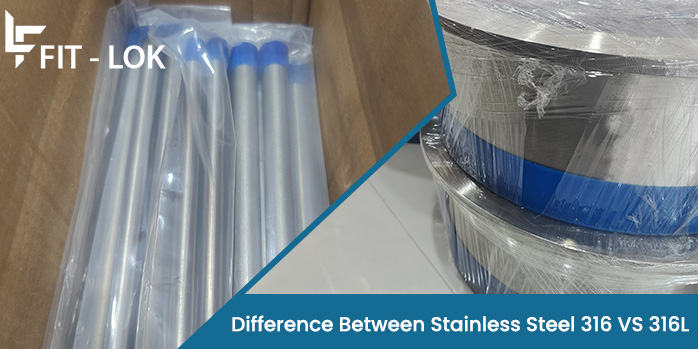
The difference between 316 and 316L is their carbon content, 316L material contains lower carbon content then 316 which makes it even more corrosion resistive.
316L Material has lower carbon content than 316
SS316 vs SS316l which is better
Alloy 316L is a better choice for projects where lot of welding required, due to its lower carbon content and resistant to weld decay as compared to 316. 316L can also withstand high pressure and temperature which makes it good choice in offshore projects.
How to Choose Between 316 or 316L Stainless Steel
If your project requires higher strength and hardness then 316 is good choice as comapred to 316L material. If it requires lots of welding then you should choose 316L over 316. Both grades offer good resistance to corrosion but Grade 316L is more resistant to intergranular corrosion. In general when welding and corrosion in main factor you should choose 316L material and when strength is required 316 grade is better choice.
Refer equivalent and chemical composition of SS 316 and 316L
Stainless Steel 316 Vs 316L Equivalent Grade
| Standard | 316 | 316L |
|---|---|---|
| AISI / ASTM (USA) | 316 | 316L |
| UNS (USA) | S31600 | S31603 |
| EN / DIN (Europe) | X5CrNiMo17-12-2 (1.4401) | X2CrNiMo17-12-2 (1.4404) |
| JIS (Japan) | SUS 316 | SUS 316L |
| BS (UK) | 316S31 | 316S11 |
| AFNOR (France) | Z7CND17-11-02 | Z2CND17-11-02 |
| GOST (Russia) | 03Х17Н13М2 | 03Х17Н13М2 |
| ISO | ISO 683/13-Fe 8 | ISO 683/13-Fe 8L |
Comparison of 316 vs 316L Stainless Steel
| Property | 316 SS | 316L SS |
|---|---|---|
| Carbon Content | Up to 0.08% | Maximum 0.03% |
| Corrosion Resistance | High | Slightly better, especially after welding |
| Weldability | Prone to sensitization (grain boundary corrosion) | Excellent; no risk of sensitization |
| Strength | Slightly higher (due to more carbon) | Slightly lower |
| Usage in Welding | May need post-weld annealing | No need for post-weld heat treatment |
| Cost | Slightly lower | Slightly higher due to low carbon processing |
SS316 vs SS316l chemical composition
| Element | SS 316 (%) | SS 316L (%) |
|---|---|---|
| Carbon (C) | ≤ 0.08 | ≤ 0.030 |
| Manganese (Mn) | ≤ 2.00 | ≤ 2.00 |
| Phosphorus (P) | ≤ 0.045 | ≤ 0.045 |
| Sulfur (S) | ≤ 0.030 | ≤ 0.030 |
| Silicon (Si) | ≤ 1.00 | ≤ 1.00 |
| Chromium (Cr) | 16.0 – 18.0 | 16.0 – 18.0 |
SS 316 have more tensile strength compared to SS 316L
Mechanical properties of AISI 316 VS 316L
| Property | Value |
|---|---|
| Tensile Strength (min) | 485 MPa (70,300 psi) |
| Yield Strength (0.2% min) | 170 MPa (24,700 psi) |
| Elongation (min) | 40% |
| Hardness (Brinell) | ≤ 217 HB |
| Hardness (Rockwell B) | ≤ 95 HRB |
| Modulus of Elasticity | ~193 GPa (28 x 10⁶ psi) |
SS 316 VS 316L Difference
| Property | SS 316 | SS 316L |
|---|---|---|
| Weldability | Good | Excellent (due to low carbon) |
| Corrosion Resistance | High | Very high in welded sections |
| Mechanical Strength | Slightly higher | Slightly lower |
| Applications | Chemical processing, marine | Pharmaceutical, welded parts |
SS316 vs SS316l Carbon Content
| AISI 316 | AISI 316L |
|---|---|
| 0.08% | 0.03% |
316L is more corrosion resistant then 316
SS 316 VS 316L Corrosion Resistance
| Property | SS 316 | SS 316L |
|---|---|---|
| Carbon Content | Max 0.08% | Max 0.03% |
| Chloride Resistance | High | High (Slightly Better) |
| Pitting Corrosion Resistance | Good | Better due to lower carbon content |
| Intergranular Corrosion Resistance | Moderate | Excellent |
| Crevice Corrosion Resistance | Good | Good |
| Stress Corrosion Cracking (SCC) | Good | Good |
| Suitability for Welding | Fair | Excellent |
| Acid Resistance (e.g., H₂SO₄, HCl) | Good | Slightly better in diluted acids |
| Marine Environment Resistance | Good | Better |
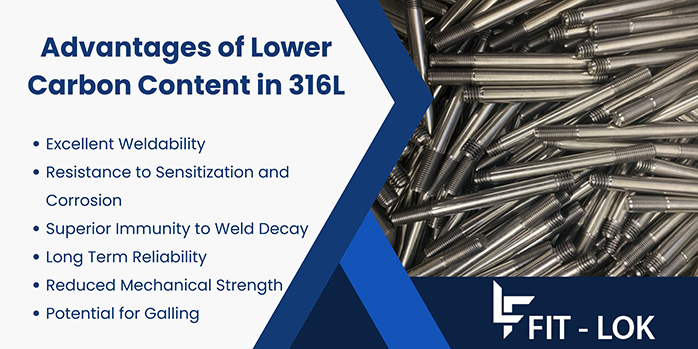
Advantages of Lower Carbon Content in 316L
Temperature limitation of Stainless Steel 316 and 316L
Both can withstand the temperature up to 870°C
316L is more costly then 316 material due to its lower carbon content
SS316 vs SS316L Price Difference
Due to lower carbon content and special manufacturing process of 316L material to reducer carbon it is costly as compared to 316. However in long term it is best to consider a 316L material for your application as its corrosion resistance properties enhances its lifespan and it required lower maintenance. If application is not that harsh then you can buy 316 material otherwise you should go for 316L by paying extra upfront cost to reduce your future expenses.
Conclusion
Stainless steel 316L is better choice for your project if strength is not a concerned due to its corrosion resistance and welding properties. Both material are similar the only difference between them is lower carbon content in 316L comapred to 316.
We are manufacturing and supplying below products from last 10 years, if you are looking to buy them feel free to contact us at sales@fit-lok.com