
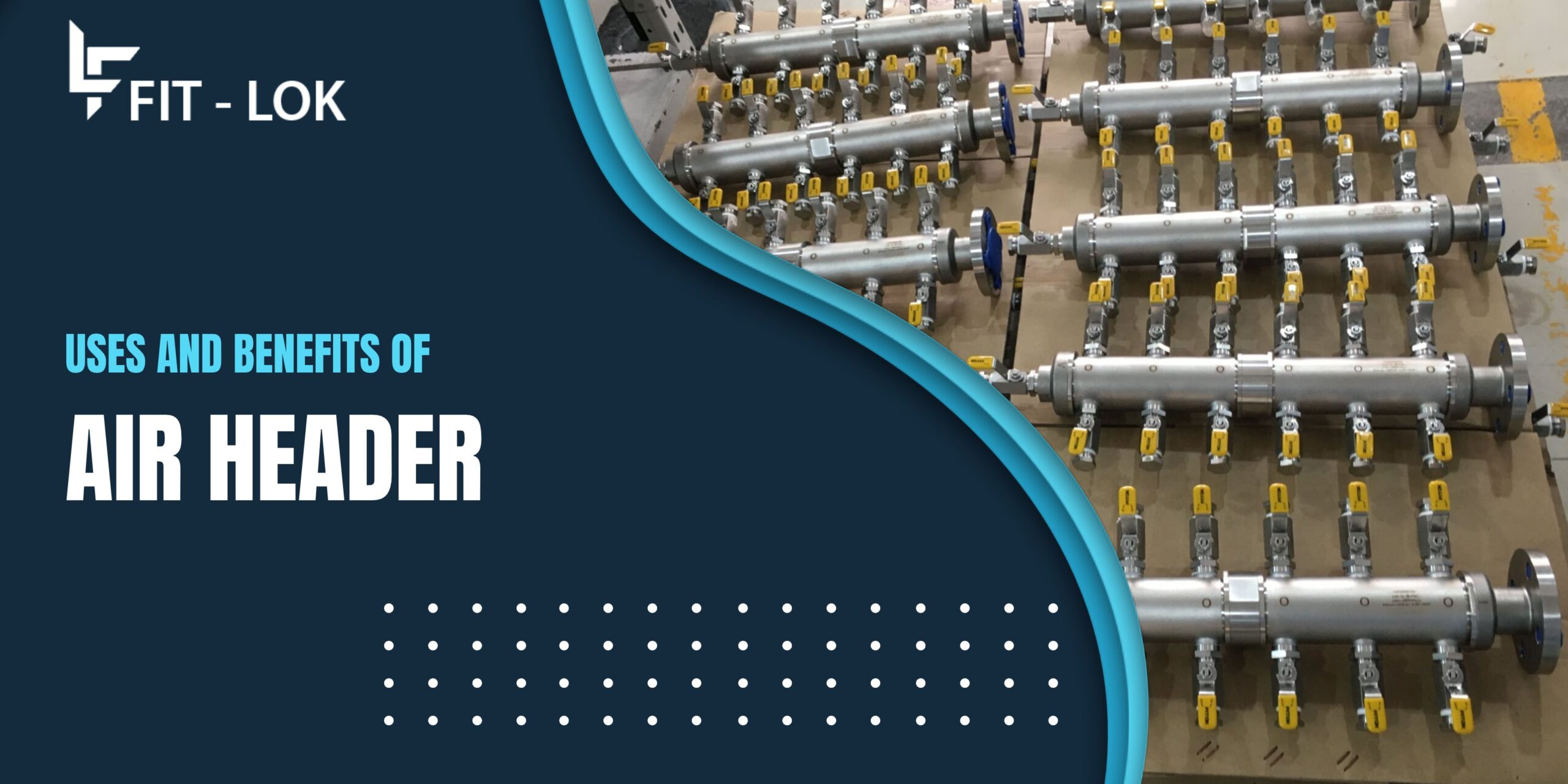
What Is an Air Header?
Air headers consist of a network of pipes and control valves that route compressed air to various equipment, control devices, and instruments. Its like a central pipe which distributes air to different instruments and equipment. These are widely used in refineries, power plants and petrochemical industry.
How an Air Header Works
Air Header is used between compressed air source and the individual devices which consumes the air. Compressed air is enter through a single inlet port and flows into a common internal chamber or bore, after which its distributed through a row of outlet ports, each fitted with its own valve.
Since every outlet has its own valve, an operator can isolate one instrument for maintenance while every other connected device keeps running normally. Many headers also include a drain valve at the low point to bleed off condensate and moisture that collects in compressed air lines, and some incorporate pressure gauges or regulators to keep downstream pressure within a safe, consistent band.
Types of Air Headers
By Configuration
Air headers are generally specified by the number of outlet ports, they provide. Common configurations range from compact 2-way and 4-way units for a handful of instruments, up to 20 way headers for instrument racks serving an entire skid or control panel. Custom configurations with mixed inlet/outlet sizes, dual inlets, or non standard mounting are also available where standard sizes don’t fit the layout.
By Material of Construction
| Material | Typical Use Case | Why It’s Chosen |
|---|---|---|
| Stainless Steel (SS304 / SS316) | Offshore, chemical, pharma, food and beverage | Excellent corrosion resistance, hygienic, long service life |
| Carbon Steel | General industrial plants, refineries | Strong, Cost effective for non corrosive environments |
| Alloy Steel | High pressure, High temperature process lines | Retains strength under extreme service conditions |
| Brass | Lighter duty instrument panels | Machinable, economical for moderate pressure use |
| Monel / Inconel / Hastelloy | Highly corrosive or offshore/subsea environments | Superior resistance to chlorides and aggressive media |
Benefits of Using an Air Header
Centralized distribution
One inlet feeds many outlets, which means less tubing, fewer joints and simpler layout. Which results in lower installation time and cost
Consistent pressure and flow
By acting as a stable distribution point, an air header helps prevent the pressure dips that happen when several devices draw air at once, keeping tool performance and instrument accuracy consistent.
Easier isolation and maintenance
Because each outlet has its own valve, one instrument or actuator can be shut off for service or replacement without shutting down the rest of the system.
Improved safety
Many air headers include drain valves to remove condensate and can be paired with overpressure protection, reducing the risk of moisture damage or pressure related failures in sensitive instrumentation.
Better air quality management
Centralizing distribution makes it easier to filter, dry, and monitor the air before it reaches sensitive devices
Scalability
Spare, plugged ports mean a facility can add new instruments or actuators later without repiping the whole system.
How to Choose the Right Air Header
Selecting the right air header comes down to matching the manifold to your system’s pressure, flow, environment, and layout. Use below checklist to specify your system:
- Flow requirement: Count the number of instruments/devices needs to be connected and choose the matching number of ways.
- Pressure rating: Confirm the header’s rated pressure meets or exceeds your system’s maximum design pressure, not just the average operating pressure.
- Material of construction: Match the material to the environment to prevent galling and corrosion.
- Valve type: Needle valves for fine manual control on instrument panels, ball valves where fast isolation is more important.
- End connections: NPT, BSP, socket weld, butt weld, or flanged – chosen to match your existing piping and site standards.
- Drain and vent provisions: Confirm a drain valve is included at the low point to manage condensate.
- Certification and testing: For critical service, ask for pressure testing, dye penetrant testing, and material certificates.
- Future expansion: Specify a couple of spare, plugged ports if you expect to add instruments later.
Key Components of an Air Header
| Inlet connection | Where compressed air enters the manifold, sized to match the supply line. |
|---|---|
| Outlet ports | Multiple take off points, commonly available in 2, 4, 6, 8, 10, 12, 14, 16, 18, or 20 way configurations. |
| Isolation valves | Needle valves or Miniature ball valves. |
| Blank plugs / bleed plugs | Seal off unused ports and allow safe venting when isolating a line. |
| Drain valve | Removes accumulated condensate and prevents moisture from reaching instruments. |
| Pressure gauge / regulator port | Used to monitor or set downstream pressure where fitted. |
| Mounting brackets | Secure the header to a rack, wall, or instrument stand and absorb vibration. |